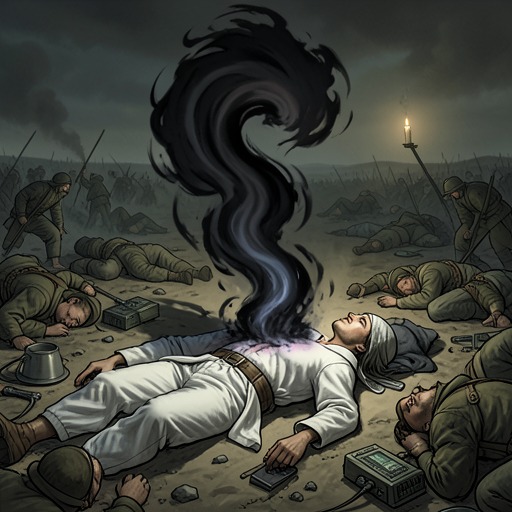
Paladin Resurrection Cycle
Bound by DarknessThe Paladin Resurrection Cycle is the extraordinary process by which Paladin warriors can die and later return to life, a power that distinguishes them from humans and shapes nearly every relationship surrounding them. It is also a source of fear rather than simple comfort: resurrection can fail, recovery can require agonizing medical decisions, and repeated returns threaten the survivor’s remaining hold on humanity. The cycle therefore turns Paladin heroism into a form of bodily and emotional debt, paid by the warriors themselves and by the people forced to watch them die, revive, and risk dying again.
Definition and Limits
The cycle permits a Paladin to come back after fatal wounds, but the narrative never treats it as guaranteed immortality. Duke remembers fighting beside Paladins who were dead one day and walking around the next, a spectacle he finds creepy and unnatural even after years of exposure to it. His reaction establishes the cycle’s central contrast: to Paladins, resurrection is part of their lived reality; to humans and guards who witness it, the return remains a violation of ordinary death.
The process has a limit that no one can precisely define. Lacey explains that no one knows how many times a Paladin can survive the cycle of living and dying without losing the last hold on humanity. Devlin Bane has been beating the odds for years, but the same pattern may not protect every warrior. Resurrection thus preserves the body without promising the preservation of the self. The unanswered number of possible returns is one of the cycle’s most frightening features, because every recovery may also be a step toward an irreversible loss of personhood.
Medical Crisis and Institutional Control
Trahern’s condition gives the cycle its clearest medical stakes. His test results have been moving steadily toward a dangerous edge, and the Paladins know that he survives only because Brenna Nichols and Laurel Young refused to abandon him during his previous death. Their intervention saved him, but the close call offered no assurance that they could help him if he died again. The cycle transforms treatment into a decision laden with ethical consequences: a healer might eventually have to end a warrior’s life after the warrior has exhausted every chance of returning, even if doing so would be the kindest available act.
The institution’s response is inseparable from its history of abuse. Colonel Kincade used scans as punishment, making a diagnostic procedure part of Paladin discipline and surveillance. Sasha Willis orders that this practice cease immediately and restricts scans to a regular diagnostic schedule unless the Handlers believe that a particular case requires more frequent monitoring. Her reform separates medical care from coercion, while her authorization of additional staff and funding for Laurel Young’s research treats the cycle as a problem to be understood rather than merely controlled.
Human Witnesses and Repeated Loss
For humans who love Paladins, the cycle produces a peculiar form of bereavement. Sasha Willis’s first love, David Booker, kept his Paladin identity secret until he trusted her with it. Two days after proposing to her, he died first from an Other’s sword and then a second time from poison administered by his Handler. Sasha later recognizes that she had not understood what had truly happened until afterward; the explanation did not lessen the fact that he was dead. Her memories remain vivid eight years later, and the pain continues to shape her understanding of Paladin life.
That wound becomes a motive for reform. Sasha is determined to direct every available dollar toward Laurel Young’s research because saving even one Paladin would be worth it to her; no one, in her view, should suffer as David did. Her private history also explains why the cycle makes a new attachment to Larem q’Jones feel dangerous. Although she barely knows him, she finds herself drawn toward him while recognizing that intimacy with another Paladin could reproduce the same devastating loss.
The cycle also returns through dreams and involuntary memory. After the barrier crisis, Sasha dreams of Others pursuing her through darkness with blood on their swords, yet she is running toward an unseen figure as well as away from danger. She wakes before seeing who waits around the corner, though she suspects the answer. The dream converts the cycle’s external threat into an internal pattern: terror and desire occupy the same movement, and the hope of safety is inseparable from the possibility of another Paladin attachment.
Social and Thematic Significance
The Resurrection Cycle complicates the boundary between human and Paladin rather than simply reinforcing it. Sasha initially sees Paladins as secretive warriors whose existence must be managed from a distance, but firsthand contact makes the institutional fear of Kalith and Paladin difference look less certain. Her sympathy for Larem q’Jones and her determination to support Laurel Young’s studies challenge the Regents’ defensive resistance to change. The cycle becomes a test of whether an organization will treat extraordinary bodies as threats, instruments, or lives deserving care.
Its effects extend into the next generation as well. After an accident leaves Sasha hospitalized, Laurel Young tells Larem q’Jones that Sasha is pregnant and asks him to provide information about Kalith pregnancies, including whether their gestation differs from the human nine-month period. Larem immediately plans to seek a medical book from Sworn Guardian Berk. The pregnancy places the cycle beside another form of bodily continuity: Paladin survival is not only about returning from death, but also about how Kalith knowledge, medical practice, and family responsibility must be carried across worlds.
In this way, the cycle is both a power and a burden. It allows Paladins to continue defending others after wounds that would end human lives, yet it denies survivors and loved ones the clean finality of death. Devlin Bane’s repeated success, Trahern’s precarious recovery, David Booker’s failed return, and Duke’s revulsion together establish a spectrum of consequences rather than a single rule. The cycle’s deepest significance lies in that instability: every resurrection appears to defeat death, while quietly asking what, exactly, has been saved.